
How to Choose the Right Software Development Technologies in South Africa


Key Summary:
- Technology stack decisions directly impact scalability, security, integration capability, and total cost of ownership, making them strategic business investments — not just IT choices.
- South Africa’s most adopted technologies include JavaScript/TypeScript (frontend), .NET/Node.js/Java/Python (backend), Azure/AWS/GCP (cloud), and AI-ready frameworks, ensuring access to strong local talent and ecosystem maturity.
- Selecting the wrong stack increases technical debt, cloud costs, security risks, and long-term maintenance expenditure by up to 30–50%, limiting innovation and slowing digital transformation.
- A structured architecture review aligned to business goals ensures scalable growth, compliance (POPIA), automation readiness, and future-proof digital transformation success.
Selecting the right software development technology is one of the most critical decisions for South African businesses aiming to modernise systems, scale operations, or drive digital transformation. Your choice of technology stack doesn’t just shape features but it determines scalability, security, integration capabilities, long-term flexibility, and overall total cost of ownership.
In this guide, you’ll discover
- Key software development technologies powering modern business systems
- How to evaluate and select the ideal technology stack for your needs
- Why technology decisions matter for business performance and growth
- When to engage a trusted technology partner to accelerate results
Whether you’re a business leader or IT decision-maker, these practical insights will help you make confident, strategic technology choices that fuel growth.
What Software Development Technologies Are Most Used in South Africa?
Whether you’re building internal business systems, customer-facing web or mobile apps, enterprise platforms, or data-driven analytics solutions, understanding South Africa’s actual software development technologies landscape is essential not just following global hype. This guide highlights the key software development technologies, including programming languages, frontend and backend frameworks, mobile and cross-platform development tools, cloud platforms, and AI/automation-ready technologies, that are shaping the local software ecosystem and driving business growth.
Frontend Technologies
Frontend technologies defines how users interact with your applications from simple interfaces to complex, data‑driven experiences. Choosing the right frontend technology impacts user experience, development speed, maintainability, and hiring feasibility. Based on trusted South African data, here’s what works and why.
HTML & CSS
HTML & CSS form the foundation for all web interfaces, powering websites, dashboards, and web applications with responsive, visually engaging designs. Nearly all South African web developers rely on HTML & CSS as the baseline for modern applications, making them indispensable for any project.
JavaScript
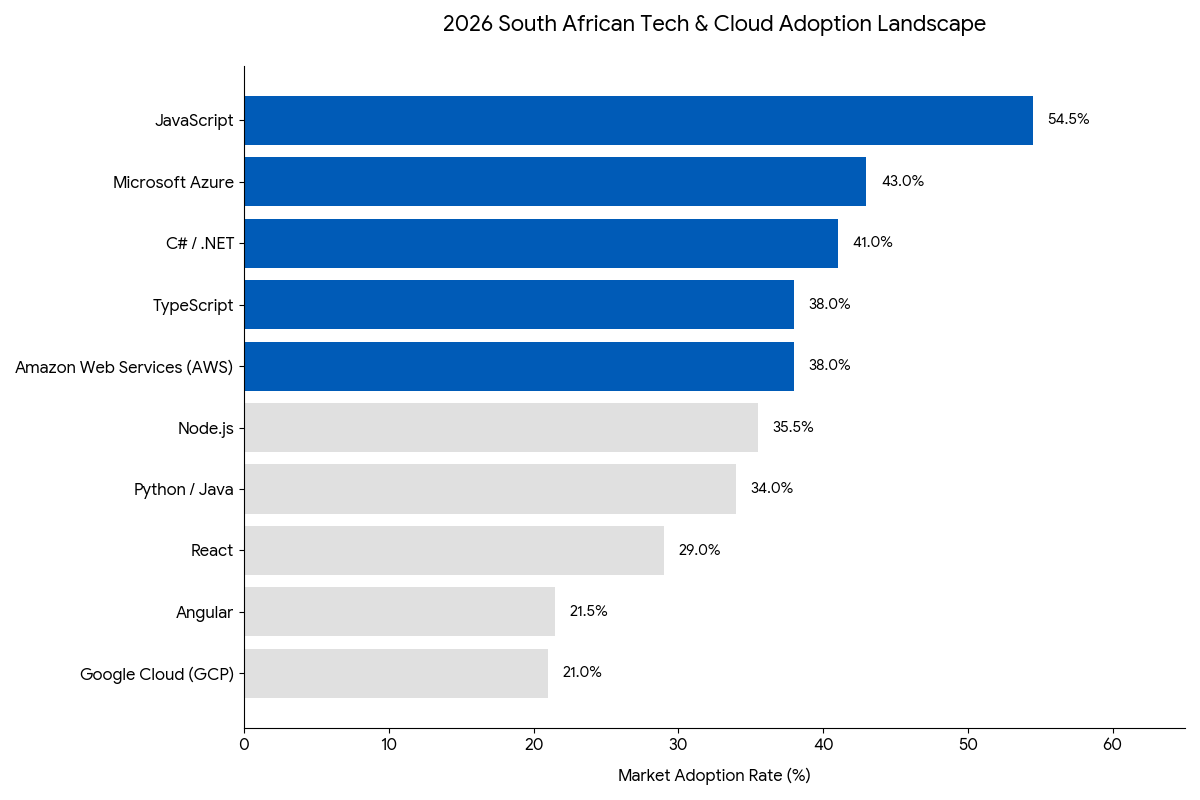
JavaScript is the core language for building dynamic and interactive web interfaces. Supported by virtually all modern browsers, it allows developers to create responsive, cross-platform applications and feature-rich user experiences efficiently. In South Africa, 54.5 % of developers report using JavaScript regularly, making it the most widely adopted frontend technology.
TypeScript
TypeScript, a strongly typed superset of JavaScript, reduces runtime errors and improves code maintainability, especially in large or enterprise-scale projects. It allows teams to scale confidently while keeping code cleaner and more reliable. Roughly 36 % of South African developers report using TypeScript, demonstrating strong local adoption for structured, maintainable frontend projects.
React
React is a component-based framework for building reusable and interactive user interfaces, suitable for both web and mobile applications via React Native. Its modular architecture enables faster development while maintaining consistency across projects. In South Africa, around 27 % of developers actively use React, making it a top choice for fast, user-focused applications.
Angular
Angular is a full-featured frontend framework often used in enterprise applications with complex workflows. It provides structured architecture, built-in tools, and strong coding conventions for teams working at scale, making it ideal for large projects where maintainability and formal architecture are priorities. Roughly 23 % of South African developers report using Angular, reflecting its steady adoption for enterprise-grade applications.
Single Page Applications (SPA)
Single Page Applications provide smooth, app-like experiences without full page reloads, improving performance and user engagement. Frameworks such as React, Angular, and Vue.js power SPAs, making them ideal for fintech dashboards, e-commerce platforms, and online banking portals in South Africa. 31 % of local web developers report building SPAs, indicating strong adoption for modern, interactive web experiences.
Progressive Web Apps (PWA)
Progressive Web Apps combine web accessibility with app-like performance, offering offline support, push notifications, and fast navigation. Technologies like React, Angular, Vue, and Ionic are commonly used. PWAs are widely adopted in South Africa for retail e-commerce, customer portals, and public service apps, where 64 % of South Africans access online services primarily via mobile devices, making mobile-first PWAs a strategic choice. (statista.com)
Mobile Interfaces
Cross-platform frameworks such as React Native, Flutter, and Xamarin allow apps to run on iOS and Android from a single codebase, reducing development costs and time. These frameworks are favored by South African startups and mid-sized enterprises for e-commerce and fintech apps, where speed and consistency matter.
Native development using Swift (iOS) and Kotlin/Java (Android) remains essential for performance-critical, feature-rich applications such as banking apps or high-traffic platforms, with around 21–29 % of local developers choosing these approaches depending on project requirements.
💡 Business Takeaways
For South African businesses, building frontend systems on JavaScript and TypeScript ensures access to the largest local talent pool and proven ecosystem support. React is optimal for fast, user-centric projects, while Angular suits structured, enterprise-scale applications. Choosing these technologies reduces hiring friction, accelerates development, and ensures maintainable, scalable systems for web and mobile.
Backend Framework
Backend technologies power the server side of your applications, handling business logic, data processing, APIs, security, and integrations. Choosing the right backend framework influences performance, scalability, developer availability, and long‑term maintenance.
C# / .NET Core
C# with .NET Core is a full-featured enterprise backend framework widely used for financial systems, government platforms, and large corporate portals. It provides structured architecture, strong security controls, and seamless integration with Microsoft enterprise ecosystems, making it ideal when compliance, long-term stability, and formal architecture are priorities. Roughly 40 % of South African developers use C#/.NET, reflecting its dominance in enterprise environments.
Node.js / Express
Node.js with Express is a lightweight, event-driven backend runtime commonly used for web APIs, mobile backends, and real-time applications such as chat platforms and collaborative tools. Its non-blocking architecture allows fast, scalable systems, making it ideal for SaaS startups, e-commerce platforms, and modern digital products. Approximately 35 % of South African developers report using Node.js, highlighting strong adoption among agile and startup-driven teams.
Python / Django / Flask
Python with Django or Flask is a flexible backend stack often chosen for AI-enabled applications, analytics platforms, and data-intensive systems. It offers rapid development capabilities and strong support for machine learning libraries, making it ideal when data processing, automation, or predictive modeling are central to the business. Around 32 % of South African developers use Python, demonstrating its growing relevance in both enterprise innovation and startup ecosystems.
Java / Spring Boot
Java with Spring Boot is a structured enterprise backend framework used for banking systems, ERP platforms, and large-scale workflow applications. It provides scalability, strong security standards, and reliable performance for mission-critical systems, making it ideal when high-volume transactions and multi-department integration are required. Approximately 34 % of South African developers use Java, maintaining its strong position in enterprise-grade backend systems.
APIs & Integration
REST, GraphQL, and gRPC are modern API technologies used to connect web and mobile applications with enterprise databases and third-party systems. API-first architectures are ideal when scalability, cross-platform integration, and cloud migration are strategic goals, especially for businesses modernizing legacy systems in South Africa.
💡 Business Takeaways
South African businesses should align backend technology with their growth strategy and system complexity. Choose .NET or Java for secure, enterprise-grade systems; use Node.js for scalable, fast-moving digital platforms; and adopt Python for AI and data-driven applications. Selecting the right stack early reduces technical debt, improves scalability, and supports long-term digital transformation across web and mobile systems.
Cloud Technologies
Cloud technologies enable businesses to host, scale, and manage applications without relying on on-premise infrastructure. The right cloud strategy improves scalability, security, disaster recovery, and cost efficiency for web, mobile, and enterprise systems.
Microsoft Azure
Microsoft Azure is an enterprise-grade cloud platform widely used for hosting applications, managing databases, and integrating hybrid infrastructure. It offers strong security compliance and seamless integration with Microsoft ecosystems, making it ideal for financial institutions, government platforms, and enterprise systems requiring structured governance. Azure remains highly adopted in South Africa’s corporate sector, particularly among businesses already using Microsoft enterprise tools.
Amazon Web Services (AWS)
AWS is a scalable cloud platform used for hosting web applications, SaaS platforms, and high-growth digital products. It provides flexible compute, storage, and DevOps services, making it ideal for startups and e-commerce platforms requiring rapid scaling and global reach. AWS continues to be one of the most widely used public cloud platforms among South African tech companies building modern digital services.
Google Cloud Platform (GCP)
Google Cloud Platform is a cloud provider known for data analytics, AI services, and scalable infrastructure. It is often chosen for machine learning projects, big data systems, and cloud-native applications. GCP is ideal when advanced analytics, AI integration, or data-heavy workloads are central to business strategy, particularly for innovation-driven South African companies.
💡 Business Takeaways
South African businesses should choose cloud platforms based on integration needs and scalability goals. Use Azure for enterprise and compliance-heavy systems, adopt AWS for scalable digital products, and leverage GCP when analytics and AI are strategic priorities. A well-planned cloud strategy improves resilience, reduces infrastructure costs, and supports long-term digital growth.
AI & Automation Technologies
AI is no longer a standalone tool; it is increasingly embedded directly into modern software systems. From backend analytics to customer-facing applications, AI enhances decision-making, automates workflows, and improves user experience. Choosing the right AI integration approach ensures intelligence is built into your web, mobile, and enterprise platforms from the start.
Machine Learning (TensorFlow / PyTorch)
Machine learning frameworks such as TensorFlow and PyTorch are used to build predictive models, fraud detection systems, recommendation engines, and analytics features directly within backend systems. They are ideal when data-driven insights and automation are core to the product strategy. Python, which powers most ML development, is used by approximately 32 % of South African developers, reflecting strong local AI capability.
AI APIs & Embedded Intelligence
AI APIs enable chatbots, document processing, speech recognition, and intelligent search inside web and mobile applications. They are ideal when businesses want to integrate AI features quickly without building custom models. Adoption of AI-driven tools continues to grow across South African enterprises pursuing digital transformation.
Robotic Process Automation (RPA)
RPA integrates with existing enterprise systems to automate repetitive tasks such as reporting, compliance checks, and data entry. It is ideal when operational efficiency is a priority without replacing core systems.
💡 Business Takeaways
South African businesses should integrate AI directly into software systems rather than treating it as a separate initiative. Use machine learning for predictive intelligence, embed AI APIs to enhance customer experience, and apply RPA to streamline operations. Strategic AI integration improves efficiency, strengthens competitiveness, and enables scalable, data-driven growth.
DevOps & Deployment Technologies
DevOps is not just process improvement — it is a measurable performance driver. High-performing DevOps teams deploy code up to 100x more frequently and recover from failures significantly faster than low-maturity teams, making tooling choices strategically important.
CI/CD Pipelines
Tools like Jenkins, GitLab CI, and GitHub Actions automate builds, testing, and deployment workflows. CI/CD adoption is now standard across roughly two-thirds of professional development teams globally, reflecting engineering maturity. Automated pipelines reduce deployment errors, shorten release cycles, and accelerate time-to-market.
Version Control
Git-based platforms such as GitHub, GitLab, and Bitbucket enable structured collaboration, branching strategies, and full change traceability. Distributed version control improves developer productivity and reduces integration conflicts. Strong version governance directly improves code quality and audit readiness.
Monitoring & Observability
Monitoring tools like Prometheus and Grafana (open-source) or enterprise platforms such as Datadog and New Relic provide real-time system visibility. Proactive monitoring can reduce downtime incidents significantly by identifying performance bottlenecks early. This protects revenue, user experience, and SLA commitments.
Containerisation & Orchestration
Docker standardises application environments, while Kubernetes automates scaling, load balancing, and container orchestration. Kubernetes is now used by a majority of enterprise cloud-native teams, reflecting its dominance in modern infrastructure management. Container orchestration improves scalability, reduces infrastructure inconsistencies, and enables resilient cloud deployments.
💡 Business Takeaways
DevOps enables faster releases, fewer system failures, and lower operational risk. By adopting CI/CD and modern deployment practices, businesses improve reliability while accelerating time-to-market. Strong DevOps maturity turns software delivery into a scalable competitive advantage.
Confused by the Complexity of Choosing the Right Tech Stack?
Gain Clear Direction with a New Phase Solutions Technology Assessment.
How to Choose the Right Software Development Technology Stack (Decision Framework)
Step 1 :Start With Business Objectives
Define the exact business problem the technology must solve. Are you modernising legacy systems, launching a customer-facing platform, or improving internal efficiency? Clarify whether your priority is scalability, automation, analytics, compliance, or real-time performance. Technology should serve measurable business outcomes, not trends.
Step 2 : Align Project Scope With Technical Capability
Match your system architecture to the complexity and growth expectations of the project. Avoid over-engineering small solutions or under-engineering platforms that must scale. Consider where the business will be in 3–5 years, not just today. The right balance prevents costly rebuilds and performance limitations.
Step 3 : Evaluate Strategic Business Criteria
Assess scalability, security compliance (such as POPIA), integration with existing systems, local talent availability, and total cost of ownership. A technically strong stack must also be commercially sustainable. Hidden maintenance costs or talent shortages can slow progress later. Make decisions that support both technical and operational stability.
Step 4 : Understand the Risk of Getting It Wrong
Poor technology choices create technical debt, vendor lock-in, and scalability bottlenecks. These issues increase long-term costs and limit innovation speed. Security vulnerabilities and integration failures can further impact business performance. Treat stack selection as a strategic investment, not just a development decision.
How the Right Technology Choices Enable Digital Transformation
Digital transformation succeeds when technology decisions are made strategically at architecture level — not reactively at tool level.
Integrated Systems: Choosing API-first backend frameworks and modern integration layers allows systems to communicate seamlessly. This eliminates data silos, improves reporting accuracy, and creates a unified operational view across departments ,which is foundational for transformation.
Automated Workflows: Selecting cloud-native infrastructure and automation-ready backend technologies enables process digitisation at scale. Instead of manual approvals and disconnected workflows, businesses build systems that trigger, process, and respond automatically, reducing cost and human dependency.
Real-Time Intelligence: Implementing scalable databases and analytics-ready architectures ensures that data can be processed in real time. When AI and advanced analytics are layered onto this foundation, leadership gains predictive insights rather than relying on historical reports.
Scalable & Secure Infrastructure: Adopting modular architectures (such as microservices) and compliant cloud environments ensures the business can grow without rebuilding systems. Secure, POPIA-aligned data frameworks protect trust while supporting expansion.
Choosing the right technology stack therefore determines whether digital transformation becomes a sustainable growth engine — or just a short-term IT upgrade.
The Hidden Cost of Choosing the Wrong Technology Stack
Most organisations only recognise technology limitations when operational friction becomes unavoidable.
Common warning signals include:
- Performance scaling becomes disproportionately expensive
- Integration projects repeatedly stall
- Security audits expose structural vulnerabilities
- Feature releases extend from weeks to months
- Cloud costs rise without clear utilisation growth
Poor architectural decisions can increase long-term maintenance expenditure by 30–50% due to rework, patching, refactoring, and workaround development.
Technology stack decisions are not merely IT choices but they are long-term financial risk decisions. A stack chosen for short-term convenience can quietly compound technical debt for years.
Is Your Current Technology Stack Limiting Growth?
You may require a structured architecture review if:
- Systems cannot integrate seamlessly with new platforms
- Developers hesitate to modernise legacy components
- Deployment cycles are slow or error-prone
- Cloud expenditure is increasing without scalability efficiency
- Security compliance feels reactive instead of strategic
If two or more of these apply, your architecture may be constraining operational agility.
Why Software Development Tech Stack Matters for Business Outcomes
Modern software is more than code but it forms the backbone of digital operations, customer engagement, and internal efficiency. The technology stack you choose directly impacts how effectively your business scales, integrates systems, and competes in a digital economy.
🎯 Integrated Systems
The right stack enables seamless data flow across departments, connecting CRM, ERP, finance, and customer platforms. This reduces duplication, improves reporting accuracy, and supports better cross-functional decision-making.
🎯 Automated Workflows
Well-architected backend systems and cloud infrastructure enable process automation, reducing manual effort and operational costs. Automation increases efficiency while allowing teams to focus on higher-value strategic work.
🎯 Real-Time Intelligence
Modern databases, APIs, and analytics frameworks convert operational data into actionable insights. Real-time reporting strengthens forecasting, performance monitoring, and competitive positioning.
🎯 Scalable Growth
Cloud-native and modular architectures such as microservices allow businesses to scale users, features, and integrations without exponential cost increases. This ensures long-term flexibility and technical resilience.
In a rapidly evolving digital landscape, particularly as AI adoption continues to expand in South Africa — future-ready businesses choose technology stacks that enable innovation, scalability, and integration rather than limiting growth.
When to Engage a Software Development Partner in South Africa
As your systems grow more complex, technology decisions begin to carry long-term operational and financial consequences. At this stage, engaging a software development consulting company South Africa can help you reduce risk, optimise architecture, and align technology with business goals. Expert guidance ensures you avoid costly rebuilds and technical debt while building scalable, secure systems.
Signs you need a partner include:
- Legacy systems that are expensive, unstable, or difficult to scale
- Disparate platforms that cannot communicate effectively
- Security vulnerabilities or compliance challenges (such as POPIA)
- Cloud migration or infrastructure modernisation initiatives
- Complex integrations with third-party tools, APIs, or enterprise platforms
Partnering early allows you to move from reactive problem-solving to proactive digital strategy and ensuring your technology enables growth rather than restricting it.
Final Thought
If your organisation is planning digital transformation, scaling operations, or modernising legacy systems, the first step should not be development but it should be architectural clarity.
New Phase Solutions provides structured Technology Assessments designed to identify architectural risk, scalability gaps, cost inefficiencies, and transformation readiness.
Before committing to a new build, ensure your foundation is strategically aligned.
FAQs About Software Development Technologies
1️⃣ How do you choose the right software development technology stack for long-term scalability?
The right software development technology stack should be selected based on business scalability goals, integration requirements, expected user load, security obligations, internal team capability, cloud strategy, and long-term maintenance cost rather than developer familiarity alone, because architecture decisions directly influence performance, flexibility, operational efficiency, and total cost of ownership over time.
2️⃣ Why is software architecture critical to digital transformation success?
Software architecture is critical to digital transformation because it determines how systems integrate, scale, automate processes, support cloud environments, and enable AI or data initiatives, meaning transformation efforts fail or underperform when legacy constraints, poor API design, or fragmented infrastructure limit agility and innovation capacity.
3️⃣ What are the financial risks of ignoring technical debt in growing organisations?
Ignoring technical debt increases long-term operational costs, slows feature development, raises security vulnerabilities, inflates cloud expenditure, and increases the probability of large-scale system refactoring projects that can cost significantly more than proactive optimisation, making technical debt a financial risk rather than a purely technical issue.
4️⃣ When should a business move from internal IT management to structured technology advisory support?
A business should consider structured technology advisory support when technology investments become revenue-critical, cloud costs rise unpredictably, integration complexity increases across multiple vendors, compliance exposure carries regulatory consequences, or architectural decisions exceed internal expertise, because at this stage mistakes have measurable financial and operational impact.
5️⃣ How does a technology assessment support executive-level decision-making?
A technology assessment supports executive decision-making by translating system architecture, technical debt, scalability gaps, compliance exposure, and cost inefficiencies into prioritised business risks and investment opportunities, enabling leadership to allocate resources strategically rather than reacting to operational failures or performance bottlenecks.